
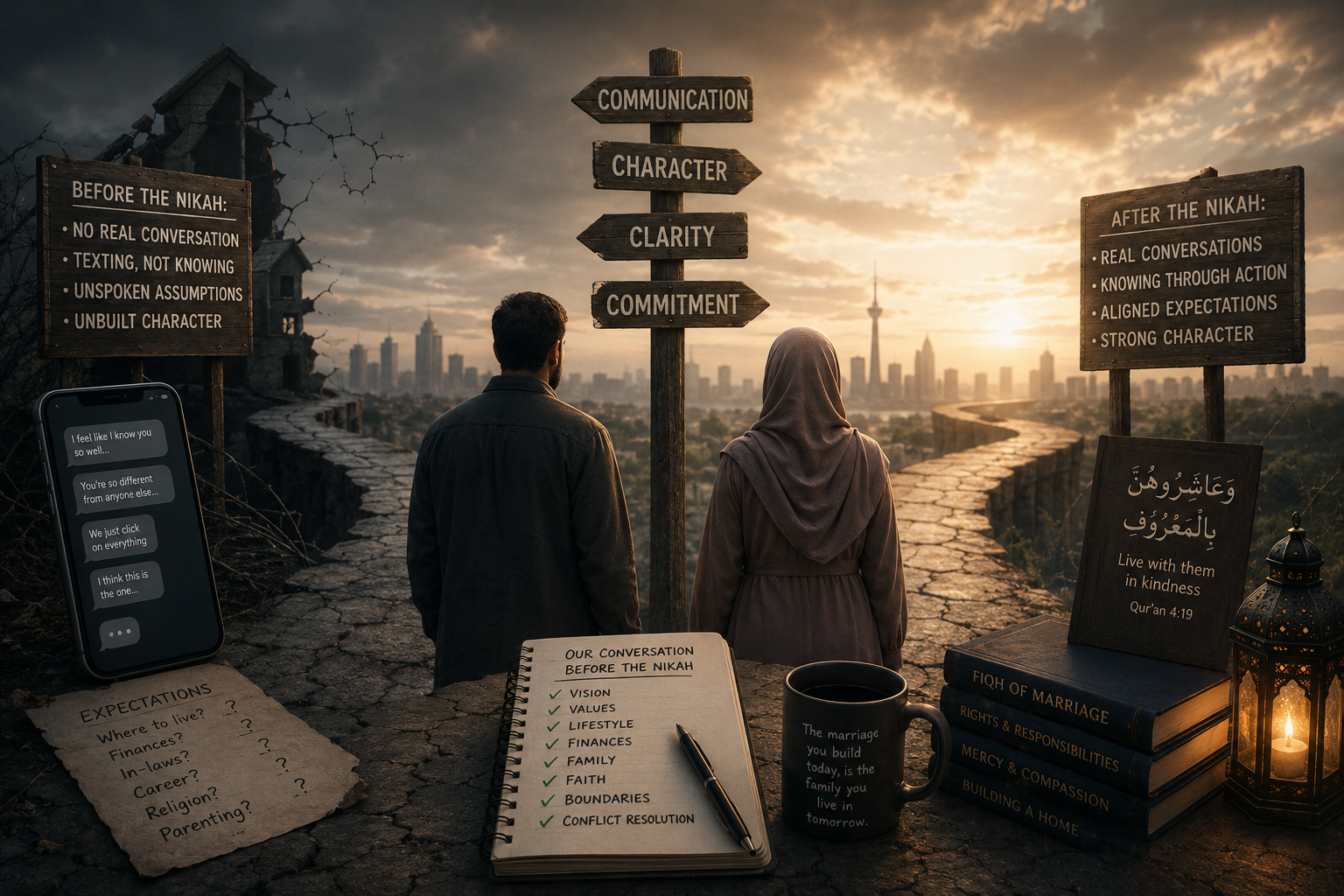
A friend of mine got married last spring. Nikah at the masjid, walima the week after, everything in order. By the end of the year they were separated. Six months ago I would have told you that story and added something about how marriage is hard and you have to work at it. I don’t think that’s the real explanation anymore.
The real explanation is that the marriage was over before it started, and nobody in the room that night had the tools to see it. Not the couple, not the families, not the imam.
I’ve spent the last couple of years trying to understand what’s happening to Muslim marriages, and I keep coming back to the same uncomfortable observation. We are not failing at marriage because marriage got harder. We are failing because the conditions a marriage needs in order to survive are not the conditions most of us are setting up before the nikah is signed.
The statistics are worse than people say
Reliable divorce numbers for American Muslims are hard to come by because nobody is keeping clean records, but the imams who do nikahs and khulas in any major North American city will tell you privately what the published reports tend to soften. In some communities, the divorce rate among Muslims married in the last decade is at or above the rate of the general American population. In a few subcommunities, second generation immigrant kids in the big metros, it appears to be higher.
That should be a scandal in our community. We are the ones who say marriage is half the deen. We are the ones whose tradition treats divorce as deeply disliked even though it is permitted. If the people who say those things are divorcing at the same rate as people who don’t, something has come loose between what we say and what we do.
I want to be careful here. I am not a scholar and I am not going to issue rulings. But I am someone who has looked at this honestly for a while, and what I see is a pattern. The marriages I see breaking are not breaking because of one big betrayal. They are breaking because they were assembled wrong. The cracks were there at the contract.
Four patterns I keep seeing
The first pattern: a conversation that used to be unnecessary
The first pattern is that two people get married having had almost no real conversation about how they intend to live. They had three or four chaperoned meetings, they exchanged some texts, they talked about kids in the abstract, they got a good feeling, and they said yes. They never talked about where they would live in five years, whether the wife would work after the first child, what role the husband’s mother would play in the household, how money would be managed, what would happen if one of them lost their faith or doubled down on it.
Here is the thing about that, though, and I want to slow down on it because I think most modern Muslim marriage writing skips over it. For most of human history, these conversations did not need to happen, because the people getting married did not need to have them. Two people from the same village, the same tribe, the same family network, raised by mothers who knew each other, in an economic structure that was the same for everyone, in a religious life that ran on a shared rhythm, did not need to sit down and negotiate where they would live or how money would work or what role the in laws would play. They already knew. Everybody knew. The script was sitting in the air around them and they slipped into it without anyone having to spell it out.
That is the model most of us inherited as our image of how Muslim marriage is supposed to work. It is the model our parents and grandparents lived inside, in the village or the small town or the neighborhood in the old country where everyone was a slight variation on everyone else. The model worked because the conditions held.
The conditions no longer hold. Globalization, mass migration, the internet, social media, economic restructuring, the collapse of the extended family household, the rise of dual income expectations, the constant exposure to other lives, other expectations, other people, all of it has produced a generation of Muslims who are nominally from the same tradition but are practically from entirely different worlds. A sister raised in a Toronto suburb by Egyptian parents and a brother raised in a Birmingham council estate by Pakistani parents are both Muslims, and they may share more deen than most of their non Muslim peers, but they are not slipping into a shared script when they get married. There is no shared script anymore. There is the deen, and then there is everything else, and the everything else has to be talked about.
This is not a sign that marriage is broken. This is a sign that the world around marriage has changed, and the work that the world used to do invisibly now has to be done by the two people getting married. The conversation is not unromantic. The conversation is the marriage doing the work the village used to do.
If you’re still in the search itself, I wrote a separate guide on how to actually find a spouse in 2026 that covers the practical channels.
The second pattern: a relationship built entirely on text
There is a version of this problem that looks like the opposite of the first pattern, and it produces the same outcome.
In this version, two people are not failing to talk. They are talking constantly. They have been texting for months, sometimes more than a year. They have shared their thoughts on everything, their hopes, their fears, their views on parenting and money and faith and family. They feel like they know each other better than anyone has ever known them. The texting feels intimate. The volume of contact feels like depth of contact.
They get married, and within weeks something starts to come apart. The person sitting across the breakfast table is not the person from the text thread. The feelings that were so strong during the months of messaging have evaporated. Each of them is privately wondering if they made a mistake.
Nobody made a mistake exactly. What happened is that text based courtship produces a specific kind of false confidence, and almost nobody is warning people about it.
When you text someone for months, you are not getting to know them. You are getting to know a curated version of them, delivered in a medium that strips out almost everything that matters for actually living together. You do not see how they handle being tired. You do not see how they handle being hungry, being criticized, being interrupted, being bored, being wrong. You see their best self, drafted, edited, sent. Even the things they share about their flaws are framed and presented. The medium does not let you see the unedited version of a person, and the unedited version is the one you are going to be married to.
Because the texting feels intimate, the attachment grows fast. Feelings build up. People interpret those feelings as love, or as compatibility, or as a sign from Allah that this is the one. What the feelings actually are, in many cases, is the brain having spent months bonding to a model of this person that the texts have built. The model has the person’s name and face on it but it is not the person. It is a sketch.
There is another layer specific to how Muslims often try to do this. The dominant cultural script for getting to know someone, the secular dating script, involves heavy texting and heavy in person time happening together, often with physical intimacy as part of the mix. The relationship is anchored in multiple places at once. Muslims trying to honor the boundaries while still using the texting tool end up with the emotional intensity of a serious relationship and almost none of the in person grounding to balance it. The emotional attachment runs far ahead of any actual knowledge of the human being on the other end. By the time the nikah happens, both people are deeply attached to someone they have barely shared physical space with, and they read the attachment as love. It is something else. It is something more like parasocial attachment, the kind of attachment fans develop to celebrities they have never met, except in this case the celebrity is texting back.
I want to be careful here. The point is not that texting is haram or that the answer is to go back to the three chaperoned meetings model. We already talked about why that model has lost the conditions it needed to work. The point is that text based courtship has a specific failure mode, and the people doing it should know that is what they are signing up for if they do not structure things to test the model against reality.
The information you need to make a marriage decision is not transmitted through text. It is transmitted through physical co presence, even brief, even chaperoned. Watching how someone behaves around their family. Around your family. Around strangers. Around stress. After a long day. When something annoying happens. When they do not know they are being watched. The texts are a supplement to that information, not a substitute for it. When people invert the ratio, when they make the texts the primary channel and the in person interactions a minor sanity check, they are building a marriage on a sketch.
There is also something the traditional boundaries are addressing here that I do not think is talked about enough. The restrictions on extended private interaction between a man and woman before nikah are usually presented as being about preventing physical sin. That is part of it. But they also protect against exactly this dynamic, the buildup of emotional intensity attached to an unreal version of a person. The classical scholars did not have smartphones, but they understood something about the human heart that the current generation is rediscovering the hard way. When you let attachment build before there is a structure to hold it, the attachment does not become a marriage. It becomes a fantasy that the marriage then has to compete with.
The dating problem underneath both
There is a deeper issue running underneath both of these patterns that I want to name, because most Muslim writers tiptoe around it.
Some scholars hold a strict position on interaction between a man and woman before nikah, that contact should be minimal, that meetings should be chaperoned, that nothing resembling courtship in the modern Western sense should take place. That position is grounded. It is traditional. It comes from a serious reading of the texts and it makes sense in light of what unrestricted male female interaction tends to produce. I am not arguing against it.
The other side of the conversation, the one you hear from a lot of younger Muslims, is that you need to actually get to know someone before you marry them, and that the only way to do that in a globalized world where you do not share a village with your potential spouse is to spend real time talking, in person, alone or close to alone, in a way that resembles what non Muslims call dating.
The word dating itself is loaded. It is not a neutral term. It comes with an entire framework attached to it. The framework assumes physical intimacy as a normal expectation, assumes a sequence of partners as part of finding the right one, assumes the relationship is about the two individuals and not about families, assumes breakup as a routine outcome. That whole framework is not ours. You cannot pick up the word dating and put it down again clean. The connotations come with it.
So here is the honest tension. The conditions that made the traditional model work in its original form do not exist for most of us anymore. And the modern alternative, in its dominant form, is built on assumptions that contradict what our tradition teaches. We are squeezed between a model that no longer has its supporting infrastructure and a model that comes with a framework we cannot accept.
I do not have a clean answer to that. I do not think anyone has a clean answer to that yet. What I can say is that the boundaries Allah set between men and women do not move when the surrounding structure changes. Those are the fixed points. The work of figuring out what a Muslim courtship looks like in a globalized, urbanized, technologically saturated world has to happen inside those fixed points, not by quietly relaxing them and hoping nobody notices. Whatever approach a person settles on, the question they have to keep asking themselves is whether they are fearing Allah in it. That question is what keeps the project ours and not somebody else’s wearing our clothing.
The third pattern: families operating on unspoken assumptions
The third pattern is that the families involved are operating on assumptions that the couple themselves do not share. The parents assumed the new daughter in law would move in. The new daughter in law assumed she would not. The husband assumed his wife would defer to his mother in the kitchen. The wife assumed her husband would defend her boundary if his mother crossed it. None of these assumptions were spoken out loud before the nikah, because raising them felt rude, and now they are surfacing one at a time, every Friday at dinner, and every disagreement is being interpreted as a character failure rather than a clash of unspoken assumptions.
This is the same root problem as the first pattern, scaled up to the family level. The old infrastructure handled it by making the assumptions identical on both sides. The new reality is that the assumptions are not identical and are very rarely surfaced in time.
The fourth pattern: character we never built
The fourth pattern is the one I find hardest to write about, because it implicates almost all of us. A lot of Muslims walking into marriage have never developed the character that marriage requires of them.
The classical tradition is full of advice about how to choose a spouse, and at the center of it is character. The well known hadith about marrying the one whose religion and character please you puts those two things together, religion and character, side by side, and it does not put them in that order by accident. Religion without character is performance. Character without religion can carry a person for a while, but it does not have the foundation to survive what marriage will throw at it.
What scholars and elders have been quietly observing is that we are producing a generation of practicing Muslims whose religion is real but whose character is undeveloped. They pray. They fast. They wouldn’t be caught dead doing anything obviously haram. And they cannot apologize. They cannot share. They cannot sit with discomfort. They cannot communicate when they are upset. They cannot regulate themselves in a fight. They got married because they assumed the religion would carry the marriage. The religion was never supposed to carry the marriage by itself. The religion is supposed to produce the character that carries the marriage. When that production line breaks, you end up with what we have now.
The honest version of this for most of us, myself included, is that we have not done the self analysis. We have not sat down and looked at our own patterns. We have not asked what we are like when we are tired, what we are like when we are wrong, what we are like when someone close to us disappoints us. We have not done the work of becoming someone whose company is easy to live inside. We assumed that work would happen in the marriage. It does not happen in the marriage. The marriage exposes whether the work has been done.
What the tradition actually emphasizes
There is something worth pointing out here that gets lost in the modern conversation about Muslim marriage. The classical scholars wrote enormously about marriage, and most of what they wrote was not about how to find a spouse. Most of it was about how to be a spouse. The rights of the husband, the rights of the wife, the etiquette of speaking to one another, the handling of conflict, the management of in laws, the responsibilities around money, the conduct inside the home. The literature on being married is much larger than the literature on getting married.
We have inverted that emphasis. Modern Muslim marriage content, the apps, the events, the matchmakers, the articles, even a lot of the masjid khutbahs in the run up to wedding season, is overwhelmingly about how to find a spouse. Much less of it is about how to be one. We have a generation of single Muslims who have read fifty articles on how to choose a partner and very little on how to remain one.
I do not say this to make anyone feel bad. I am describing myself as much as anyone. I am pointing at it because if you can see it, you can correct for it. The work of getting married well starts long before the proposal. It starts with the work of becoming someone a marriage can be built on.
The thing about the attack on the family
I want to name one more thing, and then I will stop. There is a wider context to all of this, and I think we would be naive to ignore it.
The family, not just the Muslim family, the family as such, is under pressure in a way that previous generations did not face. The economic structure makes single income households much harder than they were fifty years ago. The cultural structure rewards individual self expression over commitment. The technological structure delivers infinite alternatives into your pocket and trains you to swipe past them. The media structure treats marriage as a punchline and commitment as a kind of failure. None of this is a Muslim specific problem. We are inside the same currents as everyone else, and the currents are pulling against the kind of life our tradition asks of us.
I am not interested in conspiracy theories about who is doing this to whom. I am interested in the simpler observation that we are subjects of our environment, that the environment is hostile to families, and that we will not survive that environment by accident. We will survive it by becoming the kind of people whose marriages can hold under that pressure. That is character. That is deen. That is the work.
This blog exists because I think the work is worth doing and I think someone has to start saying these things out loud. I do not have everything figured out. I am working through it the same as you. But I would rather think through it with you than pretend I have the answers, and I would rather we go into our marriages with our eyes open than do it the way most of us have been doing it.
If you’ve read this far, you’re not just curious about marriage, you’re serious about it. That’s rare. Most people scroll, nod, and move on. You’re still here.
I run MuslimMarriageApp, and I’m doing something different. I’m personally matching Muslims who are serious about marriage, for free. No subscriptions, no swiping, no algorithm pretending to know you better than it does. You tell me what you’re looking for. I’ll tell you when I find it.
Drop your email below. I’ll send you a short form to tell me about yourself and what you’re looking for in a spouse. Then I’ll be quiet until I have something real to bring you.
No spam. Just matches when I find them.