
If you are reading this, you have probably already read ten other articles with the same title. Most of them said roughly the same things. Make dua. Fix yourself first. Trust the timing. Be patient with Allah’s plan. All of that is true. None of it is what you came here for. You came here because you are running out of ideas and you want to know what people are actually doing that is actually working.
This is that guide. I am going to walk through every real option that exists in 2026 for how to find a Muslim spouse, tell you what works and what doesn’t about each one, and try to give you something resembling a plan by the end. I am not going to pretend I have it all figured out. I am going to tell you what I have seen.
Before you start: what actually matters
I want to say one thing about preparation and then I will move on, because most articles on this topic spend the whole article on this part and never get to the actual options.
You should be the kind of person you would want to marry. If you are not, that is the first project. Not because Allah will reward you with a spouse for fixing yourself, although that may be true, but because the kind of person you find is going to be a function of the kind of person you are. The marriage market sorts people. You will be sorted into the bucket that matches who you actually are, not who you wish you were. If you are unhappy with the proposals you are getting, the most reliable lever you have is to become someone different.
That said, do not use self improvement as an excuse to delay the search indefinitely. Most people who say they are not ready to get married yet are not actually working on being ready. They are waiting. There is a difference. Start the search at the same time as the work. The work is not finished before marriage anyway. Marriage finishes it.
The five channels
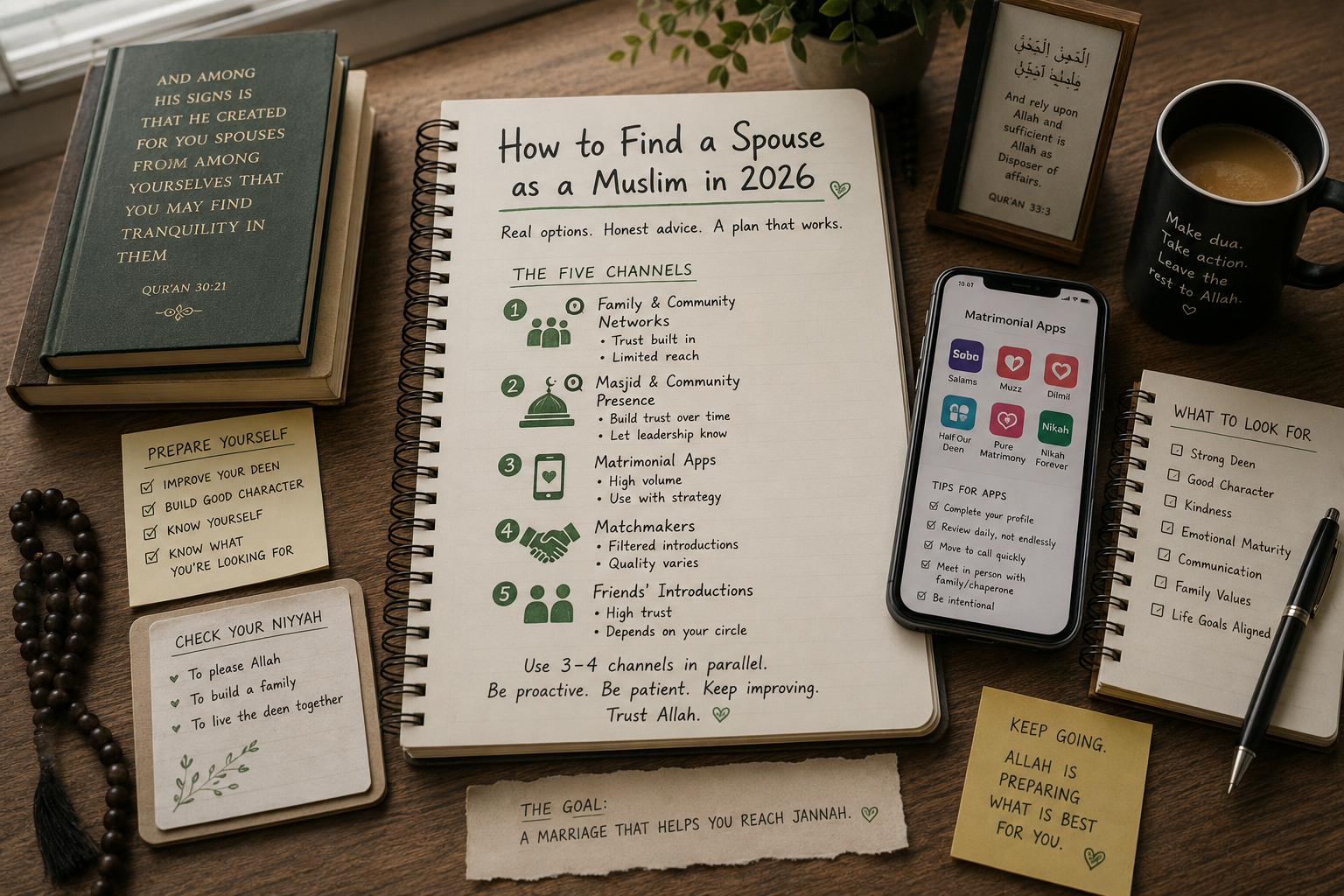
There are essentially five channels through which Muslims find spouses today. Almost everyone ends up married through one of these, sometimes a combination. I am going to be honest about each one.
1. Family and community networks
This is the traditional channel and it still works, often better than people give it credit for. Your parents tell their friends. Your aunts mention you at gatherings. Someone knows someone. A proposal comes through.
What works about it: the vetting is partially done before you ever meet. People who know both families have already made some judgment about compatibility. The introduction comes with social accountability on both sides. The drop off rate after the first meeting is lower than any other channel.
What does not work about it: it has gotten dramatically smaller over the last twenty years. The aunties who used to know everyone in the community now know a fraction of it, because the community itself has scattered. Second generation kids do not move in the same circles their parents did. Your mother’s network has fifteen viable options if you are lucky. If none of them work, you have exhausted the channel.
The other problem is that the family network optimizes for a kind of compatibility that may not match what you actually need. It optimizes for known families, similar ethnic backgrounds, similar economic class. It is biased toward replicating what already exists in the network. That is fine if what already exists in the network is what you want. It is a problem if you are a Pakistani sister who wants a serious revert brother and your mother’s network is all Pakistani families with Pakistani sons.
What to do: do not dismiss it. Tell your parents you are looking, tell them specifically what you are looking for, and let them activate the network. But do not rely on it as your only channel.
2. Masjid and community events
This is the channel everyone wishes worked better, and it deserves some careful thought because the way it is supposed to work is different from how people often expect it to work.
The masjid is a sacred space. The separation between men and women inside it is correct and the limitations on direct interaction between unrelated men and women there are correct. The masjid is not supposed to function as a meeting place where brothers and sisters survey each other across the room. The sanctity of the space depends on those limits being maintained, and we are responsible for maintaining them. If you walk into the masjid hoping to spot a potential spouse, you are using the space for something it was not built for, and you are part of the problem.
That does not mean the masjid is a dead channel. It just means the channel works differently. The way it actually works is through presence and through leadership. You attend regularly. You become known. The imam, the board members, the older respected figures in the community, the ones whose word carries weight, they start to recognize you as a serious person who shows up. You volunteer for things. You help when help is needed. You build a reputation that has nothing to do with looking for a spouse.
Then, separately, when you are actually ready, you let the leadership know that you are looking. The imam, an elder you respect, sometimes a sister in the women’s section who is known for this kind of thing on the sisters’ side, depending on the community. You give them an honest picture of who you are and what you are looking for. They do the introductions, or they pass your name along to a family they think might be a fit. The masjid functions as the trust layer, not as the direct meeting layer. The opposite gender does not need to know you exist directly. The people who can make introductions need to know you exist, and they need to think well of you.
What works about this channel: the social capital of being a known regular at a masjid is enormous when an introduction does happen. A family hearing your name from their imam is hearing it with weight behind it. That weight cannot be manufactured. It is built slowly by being there.
What does not work about it: it requires patience and it does not scale. You cannot do this in five different masjids at once. You build trust in one community, and the channel only covers that community. It also depends on the masjid having functioning leadership that is paying attention. Some do. Some do not.
What to do: pick a masjid you can commit to. Attend consistently. Volunteer. Be known for something other than your marital status. Then, when you are ready, let the right people know what you are looking for and let them work.
3. Matrimonial apps
This is where most of the search happens now, whether people want to admit it or not. The global Muslim apps like Salams, Muzz, and Half Our Deen. The South Asian leaning ones like Dilmil and Pure Matrimony. The Arab focused ones like AlKhattaba, Baklava, and buzzArab. There are regional and ethnic variants beyond these as well. They are not going away. The question is how to use them.
Before I get into what works and what doesn’t, there is something about the architecture of these apps that I want to name, because most people use them without understanding what they are actually using.
The swipe based dating app is a category that did not arise from any Islamic intuition about how marriage should happen. It was built by venture backed companies in places like San Francisco, designed for a non Muslim audience, optimized for a set of engagement metrics that have nothing to do with whether anyone actually gets married. The form was then copied and given Muslim branding. Some of the older matrimonial websites, the ones that look dated and have search filters instead of swipe decks, were actually built by Muslims with marriage in mind. The newer slick apps that dominate the space today are mostly the Tinder template with a different color scheme and a halal filter.
I am not making a conspiracy claim. The simpler observation is enough. The people who built these apps are running businesses, and the business model depends on engagement. Engagement is maximized when people stay on the app. The app does not make money when you get married. It makes money when you keep swiping. The incentive structure of the company building the tool is at odds with the outcome you are using the tool for. That is worth knowing before you spend a year on one.
What works about them: scale. The local mosque has thirty unmarried sisters in their late twenties. The app has thirty thousand. If you are looking for something specific, ethnic background, level of practice, education, location, the apps are the only channel that has enough volume to filter on multiple criteria and still leave you with anyone to talk to. They are also the only channel that works at all if you are looking outside your immediate geography.
What does not work about them: almost everything else. The signal to noise ratio is brutal. A serious sister with a complete profile will be buried under thousands of profiles from brothers who are not actually ready, not actually practicing, or not actually single. The matching algorithms are not particularly good. The conversation patterns produced by the apps, mass swiping, mass messaging, short attention windows, are bad for the kind of slow consideration that marriage requires.
The texting problem I wrote about previously lives here. Most people meet on the apps and conduct months of relationship development by text before ever meeting in person. By the time they meet, they are already deeply attached to a model of the person that the texts have built. The actual person rarely matches.
What to do, if you use them: use them as a discovery layer only. Once you find someone worth pursuing, move quickly to a phone call, then to an in person meeting with chaperones or family involvement. Do not let the relationship live on the app. The app is where you find candidates. The candidate has to be evaluated in real life. Set a maximum of two weeks from match to first phone call, and a maximum of one month from match to first in person meeting. If those benchmarks slip, the other person is not actually serious or you have built up an attachment that needs to be tested before it grows further.
Also, be ruthless about the profile review. If someone has been on the app for a year, that is a signal. If their photos are aggressively curated, that is a signal. If their writing reveals nothing about them, that is a signal. You are not being judgmental. You are being efficient.
4. Matchmakers
There has been a quiet rise in Muslim matchmakers over the last few years. Some operate professionally, charging fees and managing a private database. Some operate informally, often older women in a community who have made it their unpaid mission to introduce people. Some operate as part of organizations, masjids that have started matrimonial services, nonprofits that focus on it.
What works about them: a good matchmaker filters. They will not introduce you to someone they know is not appropriate for you. They have done the first round of screening before you ever hear about the candidate. The introductions come with accountability, the matchmaker has reputation on the line. The process tends to be faster than the apps because there is a human pushing it forward.
What does not work about them: most are not very good. Many of the informal matchmakers are running on intuition and a small mental rolodex, and the matches are often suboptimal. Many of the paid services are essentially small versions of the apps with a human in the loop, but the human does not have time to actually understand each client deeply. The good ones exist but they are rare and usually have waitlists.
What to do: if you can find a serious matchmaker, paid or unpaid, who comes recommended and who takes the time to actually understand what you are looking for, this is one of the highest leverage channels. Ask people in your community. Ask people who have gotten married in the last few years how they met. If a name keeps coming up, that name is worth contacting.
5. Direct introductions by friends
The least systematic of the channels and often the most effective. Someone you trust knows someone they think you should meet. They make the introduction. You take it from there.
What works about it: the filter is your friend’s judgment, which, if your friend knows you well, is a higher quality filter than any algorithm. The introduction comes with social accountability. The drop off rate after a positive first meeting tends to be high in the right direction.
What does not work about it: it depends entirely on whether your friends know enough single Muslims to make the introduction in the first place. If you are in a small community or your friends are mostly married, this channel may be dry through no fault of yours.
What to do: tell your married friends, tell your close single friends, tell anyone whose judgment you trust, that you are looking. Be specific about what you are looking for. People want to help, but they do not make introductions unsolicited because the social cost of a bad match falls partly on them. Lower their cost by being clear about what you want and by being someone who will handle the introduction gracefully even if it does not work out.
How to actually combine these
The biggest mistake people make is treating these as a single channel they pick from. They are running one strategy. They are on the apps, or they are waiting for their family to do it, or they are going to events. The people I have seen find spouses fastest run three or four channels in parallel.
A realistic plan looks something like this. You tell your family you are seriously looking and you give them specifics. You tell three or four close friends and you give them specifics. You identify one matchmaker or community elder who could plausibly help and you reach out to them. You sign up for one matrimonial app, you fill out the profile properly, and you commit to reviewing it once a day for fifteen minutes, not endlessly. You attend your masjid regularly and you let the leadership know quietly that you are looking.
You give this six to twelve months before you reevaluate. If after six months nothing is moving, you change one variable. Maybe you broaden your criteria. Maybe you change apps. Maybe you ask harder questions about what you are actually projecting in your meetings. You do not give up. You also do not keep doing the same thing for three years and hope it works.
What to look for when something starts moving
When a proposal does come through, however it comes, the question shifts from finding to evaluating. I am going to write a separate post on this, but the short version is that the things that matter most are character, deen, and lifestyle compatibility.
Character is what they are like when nobody is watching. You can only see this through time and through people who know them. Ask. Talk to their friends if you can. Talk to their family. Watch how they treat people they do not need to impress, the waiter, the masjid janitor, their younger siblings.
Deen is not how practicing they perform. It is the underlying relationship with Allah and the seriousness with which they take their obligations. Someone who prays five times a day but lies in their dealings has a problem with deen. Someone who misses fajr sometimes but is genuinely trying and visibly improving may be in a better place than someone whose practice is performance.
Lifestyle compatibility is the practical stuff. Where you want to live. Whether you want kids and how many. How you handle money. What your career trajectories are. What your families expect from a married couple. This is the part most people skip, and it is the part that breaks most marriages in the first three years. Talk about it. Talk about it before the nikah, not after.
The most important thing nobody says
If the search is taking longer than you hoped, you are not failing. You are not being punished. You are not too picky. Or maybe you are too picky, in which case work on that, but most people who think they are too picky are actually appropriately picky and just impatient.
The Muslim marriage market is harder than it has ever been in the modern era. The demographics are bad, the cultural infrastructure has weakened, the apps are not what they were sold as, the community is scattered. None of this is your fault. The fact that it is harder does not mean you have failed at it.
Keep going. Keep working on yourself. Keep activating channels. Keep evaluating honestly. Trust that the same Allah who has not given you a spouse yet is the one who will, when the time is right, and that your job between now and then is to be ready.
If you’ve read this far, you’re not just curious about marriage, you’re serious about it. That’s rare. Most people scroll, nod, and move on. You’re still here.
I run MuslimMarriageApp, and I’m doing something different. I’m personally matching Muslims who are serious about marriage, for free. No subscriptions, no swiping, no algorithm pretending to know you better than it does. You tell me what you’re looking for. I’ll tell you when I find it.
Drop your email below. I’ll send you a short form to tell me about yourself and what you’re looking for in a spouse. Then I’ll be quiet until I have something real to bring you.
No spam. Just matches when I find them.